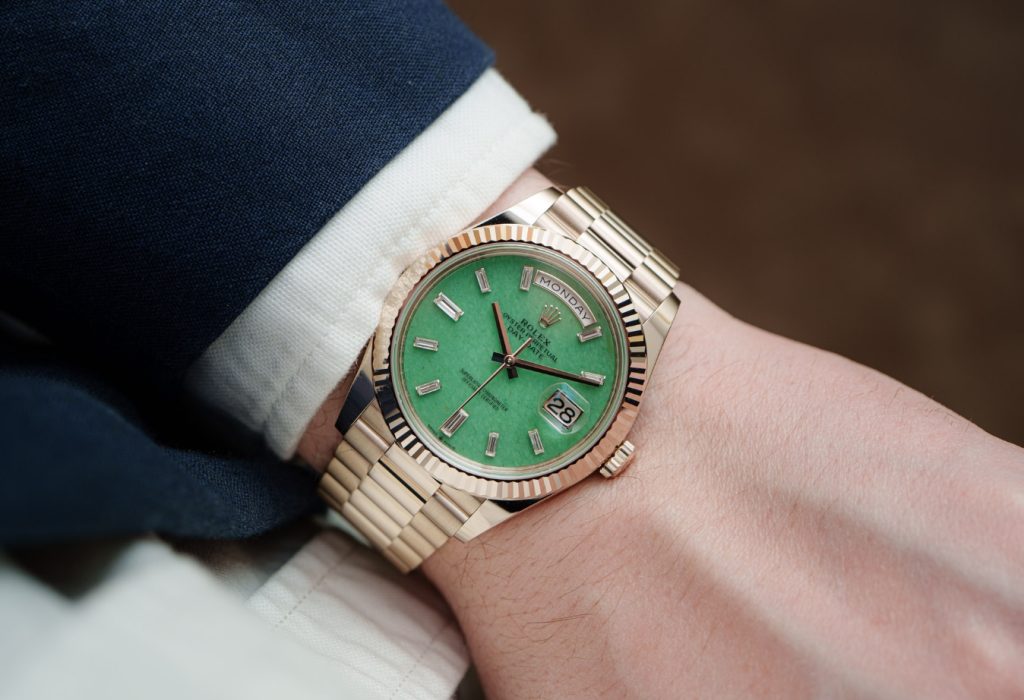
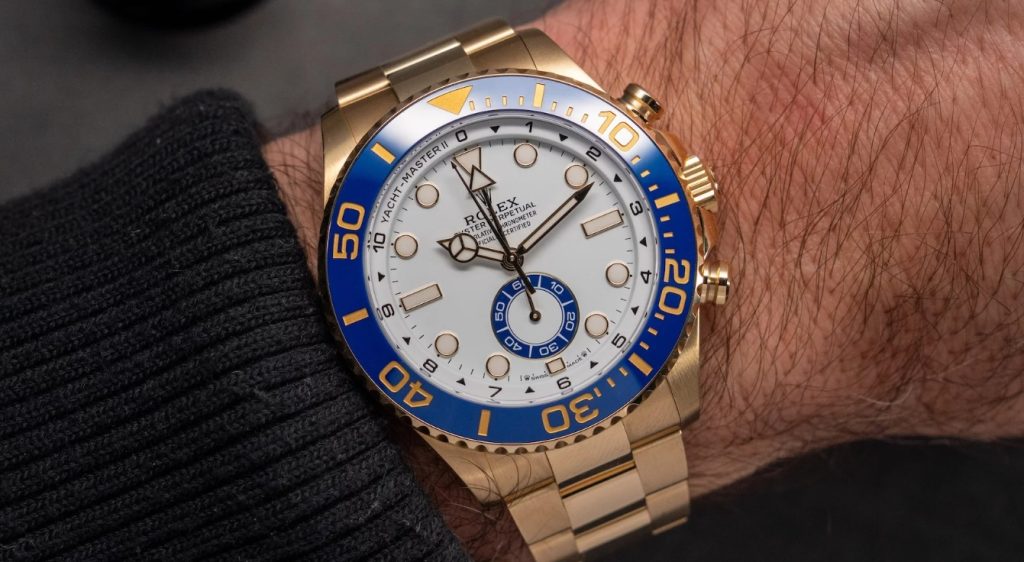
Yes, Rolex watches tick. A mechanical seconds hand advances in a series of small steps, even when those steps look like a smooth sweep at normal viewing distance. The number of visible steps depends on the movement frequency and the way the hand is driven. “It sweeps, so it must be real” is not a reliable authentication rule.
Why many modern Rolex seconds hands appear smooth
Many modern Rolex mechanical movements operate at 28,800 beats per hour, often described as 4 Hz. That produces eight balance beats per second and a visually fine-stepped seconds-hand motion. The hand is not moving continuously; the steps are simply close together.
Older Rolex movements can use different frequencies. Rolex also produced Oysterquartz models, whose quartz-controlled seconds hands behave differently from those of the brand’s mechanical watches. The model and calibre must therefore be identified before drawing conclusions from the hand.
The important modern exception: calibre 7135
The Land-Dweller’s Rolex calibre 7135 runs at 5 Hz, or 36,000 beats per hour. That corresponds to ten beats per second and is faster than the eight-beat pattern often repeated as a rule for all modern Rolex watches. Rolex documents the 5 Hz specification in its official technical material.
Our Land-Dweller calibre 7135 guide explains the Dynapulse escapement and the features that should not be copied from the genuine specification sheet into a replica listing.
What replica movements may do
Replica watches can contain many different movements. Common mechanical frequencies include 21,600 beats per hour, which gives six beats per second, and 28,800 beats per hour, which gives eight. The external watch may imitate the same Rolex reference while the movement changes between factories or batches.
A movement advertised as a “clone” may copy aspects of bridge shape, rotor decoration or hand layout while using different internal components. Conversely, a conventional movement can be reliable without resembling the original. The useful questions are the actual calibre, frequency, functions, regulation and availability of parts.
Can a phone video reveal the beat rate?
Slow-motion video may show differences between six, eight and ten steps per second, but it is easy to misread. Frame rate, shutter speed, compression and reflections can create duplicated or missing hand positions. A timegrapher or direct movement inspection provides better evidence.
Even a correctly measured 28,800-beat rate does not identify the movement as Rolex. Many unrelated mechanical movements run at that frequency.
Sound is not a dependable test
Case construction, crystal, bracelet, room acoustics and the distance from the watch all affect the sound. A loud tick does not automatically mean quartz or fake, and a quiet watch is not automatically genuine. Recordings made through a phone microphone are especially poor authentication evidence.
What to check instead
- Identify the exact reference and the genuine calibre used for that reference.
- Measure the rate and beat frequency with suitable equipment.
- Check the crown, date change, GMT or chronograph functions relevant to the model.
- Inspect dial printing, hand length, rehaut alignment, case geometry and bracelet construction.
- Compare the movement architecture, not just a decorated rotor or engraved bridge.
- For a genuine-watch purchase, use an appropriate authorised or independent specialist rather than relying on one visual trick.
The practical answer
Mechanical Rolex watches tick in rapid steps. Many use an eight-beat-per-second visual pattern; calibre 7135 uses ten, and other generations can differ. Replica movements may also produce six, eight or another rate. The seconds hand can narrow the investigation, but it cannot finish it.
For a concrete model example, our GMT-Master II 126729VTNR comparison separates the genuine calibre 3285 specification from claims made about lookalikes.